2.22.2009

Coming Full Circle: When Students Teach!

One of the rewards of teaching is reconnecting with students. Two years ago it was Judy, a student from one of my last first grade classes in Tacoma. She is now teaching herself and trying to figure out what shape her work with young people will take. I'm awed by her intellect and thoughtfulness, and humbled to think I might have played the smallest part in her learning.
And each Christmas season brings a visit from Emily, one of my amazing Pacific Oaks
College students. She is now working as a teacher educator in Nashville, and is the mom to two incredible young kids. We have stayed in touch for a decade, and nothing has been more touching than the photograph she sent of Anna, just ten months old, reading books to herself. This "simple joy and beautiful thing to see," as Emily described in her journal, got us talking about literacy once again.
Now Anna is a kindergartner, and Emily and I are corresponding about Anna's early reading instruction, as well as Emily's work with pre-service teachers. We've agreed to post some of her questions here so others can have the benefit of her insights and questions, and my attempts to address them. Her questions are similar to those of Jacqueline.
So for tonight, I've pasted in comments and questions from Emily, and over the next week, we can continue the conversation. Stay tuned.
EMILY'S QUESTIONS
In light of a balanced literacy approach that you advocate, what do you think of sight word flashcards and things like that? I am seeing a lot of this in a different light as Anna has been learning to read this year. I see her being asked to do flashcards and there are quite a few worksheets that come out of her class. I am trying to figure out what a real balanced literacy class looks like (as they say that they use balanced literacy, but it seems that perhaps it has a heavier leaning toward the phonics.)
What do you recommend as far as a specific reading curriculum? (If we don't use the textbooks, what is the best way to supplement the curriculum if teachers are just starting out with few resources?)
Would you remind me of the exact context in which you used the coded reading books (phonics, skills, holistic) in our Language and Literacy class? [Note: Emily borrowed these coded texts from me this winter so that she could use them with her own students.] What was the objective in relation to the rest of what you had already been working with us on? I just want to make sure that I am using this experience to its maximum potential! I remember it being powerful because I had been teaching Distar (which was hard for me to swallow) and this showed me how some kids might view it.
I was reading the book New Policy Guidelines for Reading and loved that page that showed the writing samples from the three different classrooms. In classrooms where real literature is used, it seems that everything improves (reading, writing, language in general). Is this going to hit the mid to higher readers or will it hit everyone from your experience? (I am trying to think about some of my struggling readers and writers and wondering if I would have seen that kind of writing from them-- the kind in the final sample.)
What about the kids who are really struggling? I remember when I was at XYZ school that some of the folks brought in Distar because they wanted to make sure that the kids had a phonics background. They were concerned that they had no foundation with this so they chose this route. (And it totally bored the higher-level readers. I recall that this was not really engaging for the struggling readers either--it just seemed that folks thought that we had to give this foundation or they would not get it from the other literature).
Also, what about Reading Recovery models? Don't they just go back to the phonics? Hmm--are we doing this all wrong? Do we just need to get to reading good literature? Doesn't "balanced literacy" try to focus on some phonics too?


2.02.2009

To Teach Well is to Learn From Children

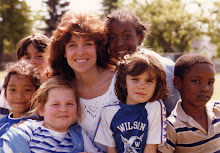
Hello again. My time away from the blog means I've been busy with other endeavors, including several pieces for the print world. I also wrote an essay for the National Public Radio project, This I Believe. My essay is now in their library, although it wasn't selected to be recorded for radio. I share it below, as it includes the writing of several students in my blog photo: Mandy, Erin, and Makeesh.

I believe that to teach well is to learn from children. My students have taught me about how they learn, about their vulnerabilities and strengths, and most importantly, about myself.

Thirty years ago I became a teacher. Perhaps it was an expected choice for a teenager who volunteered in the church nursery and helped to raise younger siblings. After college I learned the ropes of teaching on the job, then fine-tuned my knowledge in graduate school. But in the end, it has been the students themselves that have most helped me become the teacher I am. The more I learned from them, the more I valued them, and the more I valued them, the more I paid attention to their strengths, needs, and interests.

For over twenty years I learned about children in the presence of six and seven year olds, and nothing better documents the small gems of my learning than the students’ writing. The students and I kept journals, writing back and forth daily to one another, which certainly provided writing opportunities for these beginning authors and allowed my writing to serve as an example. Yet, beyond the journals’ practical role of helping the students grow as readers and writers, the students’ entries introduced me to the amazing intelligence and thoughtfulness of young children.

Thin and quiet, Mandy’s personality was mirrored in her spare, beginning writing. In the spring I wrote about the garden I was planning, and Mandy asked what I would plant. I responded that I wasn’t sure, but that I didn’t have room for flowers and vegetables both. She advised that I better choose so the plants wouldn’t get stepped on. Even though her spelling was becoming easier to read, it would have been easy to miss the humor she found in her own advice and the small happy face that punctuated it. A month later Mandy’s family moved. In her journal she wrote, “Please don’t ever, ever forget me.” Because of Mandy, I took even more care to notice and respond to the ideas that kids shared.

It was most common for students to write about their daily experiences. Michael wrote, “Yesterday when I got off the bus little puffs of wind passed by. It felt good to me.” And Joseph noticed that “the snow looked like gold” on his way to school and illustrated his description with bursts of color across a white lawn. It was a surprise to me that six year olds experienced these kind of small moments much like I did and that they could so vividly describe their experiences.

Even if a writing assignment was contrived, like one I borrowed after hearing kids’ responses on the Johnny Carson show, first graders continued to teach me. I asked the kids what spring fever meant, and James wrote: “[It] means that more people might be getting fevers or colds, or the sniffles. But it might mean people are finding more lovers. It might mean the flowers are going away. Or more people are getting tired. It might mean you stay inside and dance.” Joseph, in contrast, approached me several times to say he didn’t know what to write. In spite of my assurance that he should do his best, I later found his paper on my desk with a small note stapled to it: “I ain’t gonna do this. I don’t know how.” My students’ writing transformed the quick laughs on the Carson show the night before. The sincerity of their efforts called me to treat their writing with respect, not as a source of amusement. I learned that their ideas mattered and could inspire amazing life poetry.

Erin brought a keen eye to the talents of her classmates and used writing to compliment them during an end-of-the-year letter project. It seemed she intuitively understood the encouraging power of words: “Dear Arthur,” she wrote. “I like you because you’re like the Incredible Hulk. You’re cool all the time, too. You’re snazzy and jazzy and razzamatazzy. You are the best fighter.” And to Krista she wrote, “I like you because you are beautiful and so calm. You’re so unique, so intelligent, so feminine. You sing nicely. You look like a ballerina. Love, Erin.” In letter after letter, she identified her classmates’ strengths. Most poignant was the letter she wrote to herself: “Dear Me, I like you because you’re an author and you went to the Young Author’s Conference. I’ll tell you a secret. How about it, me? Okay, here’s the secret. Me, do you have any friends?” Makeesh decided to write a second letter to Erin, warning her that, “You shouldn’t write to your own self. People be talking!”

Over a career I’ve taught every subject area, including music and art, as well as my area of expertise, literacy. I’ve developed lessons based on research and national standards, and used many different curriculum materials to support kids’ learning. But in the end, the most important work I’ve done is to help students develop the tools to make sense of their experiences, to express their ideas, and to follow their passions. Then I’ve paid very close attention, allowing me to form a relationship with each one. And while I’ve played an important role as the teacher, I’ve also been privileged to be a part of each unique classroom community.

Indeed, when Anne wrote, “You are very, very, very, very, very, very, very, very special, Ms. Egawa,” I became more of that special teacher who has now touched the lives of close to 2,000 children. I never imagined these experiences when I chose teaching as my life’s work.

I now carry within me a rich tapestry woven from each of these young voices, much of it preserved in writing. Their observations of the world changed how I see it, and how I see myself. Fortunately, I’ve also learned that a teacher’s learning is never complete. Seth reminded me of this final point on his last day of first grade: “Dear Ms. Egawa, You weren’t always a good teacher, but when you were, it was fun.”

12.02.2008

Making Izzy's Gnocchi with Nick

You may have read an earlier post on my work with Nick, a nine year old who taught me a lot about working with older beginning readers. When I share our accomplishments with others, I always advocate that adults help learners use literacy to explore a keen interest, even at the earliest phases, essentially taking the focus off learning to read and write and actually using reading and writing to learn. For some kids, it's reading ads about fashion or media, for others it's IMing. Nick and I first studied crows, and then moved on to cooking.

Nick's interest was clearly piqued by food, in part because his dad works in the restaurant industry. His passion lead me to schedule a gnocchi-making lesson with Aunt Izzy, a legend at the Batali family outpost, Salumi. Here they are working together, along with a second photograph Nick took during Izzy's lesson. (She was a great teacher, so I wasn't surprised to find out that she had taught kindergarten for many years!)

Nick wrote out the ingredients, and I later helped scribe the instructions in his own words. Just this week, two years after that lesson and several months after Izzy sadly passed away, Nick came over to make gnocchi. We took out his recipe and followed it again.

Aunt Izzy’s Gnocchi
By Nick 1/07

INGREDIENTS
500 grams potatoes (approximately one pound)
300 grams flour
2 eggs
2 t. salt

Your favorite sauce
Parmigiano Reggiano cheese
Serves 4-6

DIRECTIONS

1. Put the potatoes in a large pot of boiling water. We used Yukon Gold potatoes. Cook until they are tender. Cool and peel them while they are still warm.

2. Put another large pot of water on to boil while you make the gnocchi. Put the sauce on the stove to warm at the same time.

3. Press the potatoes through a ricer onto a clean counter covered with a little bit of flour. Add the flour and salt so it makes a mound and then make a hole in the middle. Crack the eggs into the hole.

4. Start to stir with your fingers mixing in the flour and potatoes and if you think it is soft enough, make it into a ball and knead it until it’s smooth. Leave it alone for 5-15 minutes.

5. Flatten the ball and cut the flattened side into 6 strips (or so).

6. Make sure you have just a little flour on the table or counter. Roll one of the strips like a snake until it’s about as big around as your thumb. You might have to break it into two or three pieces as it gets longer. It helps to spread your fingers out as you roll it.

7. Take a knife and don’t saw it, cut the snakes into pieces about as big as the length of your finger from the first knuckle to the tip, or a little more than half an inch. The flour on the table should keep the gnocchi from sticking together but don’t use too much.

8. Roll the gnocchi on a fork or a gnocchi board to make the ridges. Izzy likes to make ridges on the gnocchi because the sauce sticks better. You roll it with your thumb making a little impression in the middle. It takes practice and some people are better at it than others.

9. Put the pieces onto a tray with about 3-4 tablespoons of cornmeal so they don’t stick together.

10. When the water is boiling, put half of the gnocchi in the pot. The gnocchi will sink to the bottom and then float to the top. After it floats to the top, cook it for one more minute. Then scoop it out into a colander to drain and do the same thing to the rest of it.

11. Serve the gnocchi in warm bowls with a couple spoonfuls of sauce. Grate the cheese over the top.

12. EAT IT!


I can't think of a better homework project--a solid hour+ of work--for a kid who was once described as lacking focus. What interests the kids in your life? How could you use reading, writing, sketching, and photography to learn more?